Getting your website to appear in Google search results can be difficult, especially when you’re competing against established websites.
One way to improve your chances is to target low-competition keywords: search phrases that may offer opportunities to create useful content without competing directly against the strongest websites for every topic.
Thus, here are three simple ways to find them among low competition keywords.
1. Use Google Search Suggestions
Start typing a topic related to your website into Google.
For example, if your site covers affiliate marketing, try phrases such as:
Affiliate marketing for beginners
Affiliate marketing without a website
Free affiliate marketing tools
These suggestions can reveal related topics people may be interested in exploring.
Remember, suggestions don’t prove that a keyword has low competition keywords. Additionally, use them to generate ideas, then examine the search results.
2. Target Specific Search Phrases
Broad keywords can be highly competitive. More specific phrases often reveal a clearer search intent.
For example, instead of targeting “SEO tools,” consider “free SEO tools for a new website.”
A specific phrase may attract fewer searches, but it can help you create an article that answers a particular question.
Before choosing a keyword, search for it and examine the results. Look for opportunities to provide clearer explanations, more practical examples, or more useful information than existing pages.
3. Use Free Keyword Research Tools
Free tools can help you discover related keywords and understand search demand.
Getting visitors to a new website can be challenging. Publishing useful articles and sharing content helps, but SEO tips for beginners still take time to attract traffic.
That’s where SEO tips for beginners come in.
SEO tips for beginners help search engines understand your content and help people discover pages that answer their questions. You don’t need to be an expert or buy expensive software to start improving your website.
In this guide, you’ll learn seven practical SEO tips for beginners that can help you build a stronger foundation for long-term website traffic.
1. Choose the Right Keywords Before Writing
One of the biggest SEO mistakes beginners make is writing articles without considering what people are searching for.
Keywords are the words and phrases people enter into search engines when looking for information, products, or solutions.
For example, someone interested in affiliate marketing might search for:
How to start affiliate marketing
Best free tools for affiliate marketing
How to get website traffic without ads
How to choose affiliate products
Each phrase represents a potential article topic.
Before writing, choose one main keyword that closely matches the purpose of your article. Then consider related questions that readers may want answered.
You can discover keyword ideas using Google’s autocomplete suggestions, related searches, and free keyword research tools.
Don’t focus only on search volume. Broad keywords can be highly competitive, while more specific searches may give a new website a better opportunity to provide a useful answer.
Beginner tip: Choose a keyword that matches your article and the needs of your intended audience. Never force a keyword into a topic where it doesn’t belong.
2. Write Content That Answers the Searcher’s Question
Finding a keyword is only the beginning. Your article must also provide a useful answer.
Imagine someone searches for “how to get free website traffic.” They probably want practical methods they can use without paying for advertising.
An article that only explains why traffic matters won’t fully address their needs.
Instead, explain specific methods, show readers how to use them, discuss common mistakes, and provide realistic expectations.
Before writing an article, ask yourself:
What problem is the reader trying to solve?
What information do they need first?
What practical steps can I provide?
What questions might they still have after reading?
Use clear headings, short paragraphs, examples, and lists to make your content easier to navigate.
Avoid adding unnecessary words just to make an article longer. A focused article that satisfies the reader’s needs is more valuable than a lengthy page filled with repetition.
For more guidance, read Google’s official SEO Starter Guide, which explains how to help search engines discover and understand your website.
Google’s SEO Starter Guide is a useful official resource for understanding how to make your website easier for search engines to discover and understand.
3. Optimize Your SEO Title and Meta Description
Your SEO title helps search engines and potential visitors understand what a page is about.
Your meta description provides a short summary that may appear beneath the title in search results. Search engines can choose different text from your page instead, so a meta description does not guarantee a particular snippet.
For example, if your article targets the keyword “SEO tips for beginners,” you could use:
SEO title: 7 SEO Tips for Beginners to Get More Traffic
Meta description: Discover 7 SEO tips for beginners to improve website visibility, optimize content, and attract more visitors from search engines.
Your title should accurately describe the article and give readers a reason to click. Your description should explain what they will learn without making unrealistic promises.
If you use the AIOSEO plugin in WordPress, you can enter these details in the post’s SEO settings.
Avoid repeating the same keyword unnaturally or writing titles that promise results your article cannot deliver.
4. Use Headings to Organize Your Content
Headings make your articles easier to read and help readers find the information they need.
They also provide useful structure for search engines.
Use one clear H1 heading for the main article title, followed by H2 headings for the main sections. Add H3 headings when you need to divide a section into smaller topics.
For example:
H1: 7 SEO Tips for Beginners to Get More Website Traffic
H2: Choose the Right Keywords Before Writing
H2: Write Content That Answers the Searcher’s Question
H2: Optimize Your SEO Title and Meta Description
H2: Build Helpful Internal Links
Keep headings descriptive and relevant to the section that follows.
Don’t add keywords to every heading just because you want to improve rankings. Natural, helpful headings are easier for people to understand.
5. Add Internal Links to Related Articles
Internal links connect one page on your website to another page on the same website.
They help visitors discover related information and provide search engines with additional context about how your content is connected.
For example, if you’re writing about SEO, you might link to an article explaining how to attract visitors without paid advertising.
This link provides a relevant next step for the reader.
You can also link between related articles within the same category. An article about keyword research might link to a guide about writing SEO-friendly content.
When adding internal links:
Use descriptive anchor text.
Link to pages that genuinely relate to the topic.
Check that the destination URL works.
Add links where they help readers, rather than inserting them randomly.
As you publish more articles, revisit older posts and add links to relevant new content.
6. Make Sure Your Website Is Easy to Use
A website should work well for visitors on computers, tablets, and mobile phones.
If pages are difficult to navigate, slow to load, or hard to read, people may struggle to use them.
Start with these basic checks:
Mobile usability: Make sure text is readable and buttons and links are easy to use on smaller screens.
Loading speed: Compress oversized images, avoid unnecessary plugins, and use suitable hosting.
Navigation: Organize your main pages and categories so visitors can find related content.
Security: Use HTTPS and keep WordPress, themes, and plugins updated.
Technical accessibility: Check that important pages can be crawled and indexed by search engines.
You can use Google Search Console to monitor your website’s search performance, inspect indexing information, and identify certain technical issues.
You can also use PageSpeed Insights to test page performance and discover possible improvements.
You don’t need to fix every technical detail immediately. Start with problems that prevent visitors from accessing your content or make the website difficult to use.
7. Track Results and Improve Your Articles
SEO is an ongoing process. Publishing an article doesn’t mean it will immediately appear near the top of search results.
Some pages may attract visitors relatively quickly, while others may take months to gain visibility. Results depend on factors such as competition, content quality, website history, and search demand.
Instead of guessing, monitor what happens after publication.
Google Search Console can help you see which search queries generate impressions and clicks, which pages appear in search results, and how your performance changes over time.
Use this information to identify opportunities.
For example, if an article receives impressions but few clicks, consider whether the title and description accurately communicate its value.
If a page attracts visitors but doesn’t answer their questions well, improve its examples, structure, or explanations.
If an article ranks for a related question you haven’t addressed, consider adding a useful section.
Avoid changing everything at once. Make thoughtful improvements and monitor the results.
Common SEO Mistakes Beginners Should Avoid
As you build your website, watch out for these common mistakes.
Keyword stuffing: Repeating the same phrase unnaturally can make your writing difficult to read. Use keywords naturally and include related terms where appropriate.
Publishing thin content: Articles that offer little original value may struggle to satisfy readers. Focus on answering questions thoroughly.
Ignoring search intent: A reader looking for a step-by-step tutorial needs a different article from someone comparing products.
Building links without a clear purpose: Internal links should help readers navigate relevant content. Avoid adding unrelated links simply to increase their number.
Expecting instant rankings: SEO takes time, and no legitimate strategy can guarantee a particular position in search results.
Forgetting to update old content: Broken links, outdated prices, and incorrect information can reduce an article’s usefulness. Review important pages periodically.
Final Thoughts
SEO doesn’t have to be complicated when you’re starting out.
Begin with a clear keyword, create content that answers real questions, write useful titles and descriptions, and connect related pages through internal links.
Then make sure your website works well on mobile devices and use Google Search Console to understand how your pages perform.
You don’t need expensive tools or dozens of plugins to begin. Consistent improvements and useful content can help you build a stronger foundation for attracting visitors from search engines.
Your next step: Choose one existing article on your website. Review its main keyword, title, headings, internal links, and usefulness to readers. Improve one or two areas, then monitor its performance over time.
SEO results vary, but every useful improvement gives you a better opportunity to serve your audience and grow your website.
Choosing the right affiliate products can make a big difference when you’re trying to earn money from a website.
Additionally, you could publish helpful articles, attract visitors from Google, and share your content on social media.
However, if you don’t know how to choose affiliate products for your audience, converting visitors into customers can be difficult.
The good news is that you don’t need to promote dozens of products to get started. A small selection of relevant products can be enough to build a focused affiliate marketing strategy.
In this guide, you’ll learn how to choose affiliate products that solve real problems and fit your niche, and offer a reasonable opportunity to earn commissions.
1. Choose Products That Match Your Website’s Niche
Start by looking at the main topic of your website.
If you run a website about fitness, your audience might be interested in workout equipment, training programs, or fitness applications. If your website covers online business, readers might be looking for website hosting, email marketing services, or content creation tools.
The closer a product is to your audience’s interests, the easier it is to explain why it might be useful.
For example, imagine you publish articles about starting an online business. Recommending a keyword research tool in an article about finding content ideas makes sense. Promoting an unrelated kitchen appliance in the same article probably doesn’t.
Ask yourself three questions:
Does this product fit my website’s topic?
Would my readers realistically consider buying it?
Can I explain how it helps solve a problem they have?
If the answer to these questions is yes, the product may be worth investigating further.
2. Focus on Products That Solve Real Problems
People don’t usually search for products simply because they want another product. They often want to solve a problem, save time, learn a skill, or make a task easier.
Your job is to understand that problem and identify products that may help.
For example, someone searching for ways to create videos without appearing on camera may appreciate a comparison of video editing tools.
A beginner struggling to attract website visitors might benefit from an article explaining SEO tools, keyword research, and free traffic strategies.
Think about the questions your readers ask before making a purchase. These questions can become useful article ideas, including:
How does this tool work?
Is it suitable for beginners?
What are its main advantages and disadvantages?
How much does it cost?
Are there free alternatives?
Is it worth paying for?
By answering these questions honestly, you can help readers make informed decisions while introducing relevant affiliate products.
3. Research the Affiliate Commission
Not all affiliate programs pay the same amount.
Some offer a fixed commission for each qualifying sale. Others pay a percentage of the purchase price. Certain programs also offer recurring commissions when customers continue paying for a subscription.
However, a larger commission doesn’t automatically make a product the better choice.
Consider two hypothetical products:
Feature
Product A
Product B
Commission per sale
$10
$40
Audience relevance
High
Low
Product quality
Good
Uncertain
Recommendation
Potentially suitable
Needs more research
Product B pays more, but that doesn’t mean you should promote it. If it doesn’t meet your readers’ needs or you cannot verify its quality, Product A may be the more sensible option.
Before joining a program, check the commission structure, payment threshold, cookie duration, payout schedule, and any restrictions on how you can promote the product.
Treat commissions as one factor in your decision, not the only factor.
4. Check the Product’s Quality and Reputation
Your readers trust you to provide useful information. Recommending poor-quality products can damage that trust.
Before promoting something, investigate the company and its offering.
Look for independent reviews, clear pricing, accessible customer support, and information about the product’s features and limitations.
If possible, test the product yourself. Hands-on experience can help you create more useful tutorials and explain details that aren’t obvious from a sales page.
If you cannot test it, be transparent about that fact. You can still write an informative comparison using reliable information, but don’t claim personal experience you haven’t had.
Pay particular attention to recurring subscriptions. Check whether pricing changes after an introductory period, whether cancellation is straightforward, and whether important features require a more expensive plan.
The goal isn’t to find a perfect product. It’s to find something you can recommend responsibly.
5. Look for Products With Genuine Buying Interest
A product may be excellent, but that doesn’t necessarily mean people are searching for it or actively considering a purchase.
Research what potential customers want to know.
You can start with free methods:
Enter relevant phrases into Google and examine the suggested searches.
Look at the questions appearing in search results.
Read discussions in relevant online communities.
Explore competing articles and identify questions they haven’t answered well.
Check whether people are searching for comparisons, reviews, tutorials, or alternatives.
For example, a broad article about video editing may attract readers who are only researching the topic. An article comparing video tools for beginners may attract people who are closer to choosing a solution.
Neither type of content is inherently better. Informational articles can attract new visitors, while comparison content can help readers who are evaluating their options.
Remember that search interest doesn’t guarantee sales. It simply gives you clues about what your audience wants to learn.
6. Compare Affiliate Programs Before Joining
Once you’ve identified a promising product, examine its affiliate program.
Here are some factors to compare:
Commission structure: Is the payment a percentage, a fixed amount, or a recurring commission?
Cookie duration: How long after a referral click can a qualifying purchase potentially earn you a commission, subject to the program’s rules?
Conversion process: Is the purchase process clear and easy to understand?
Payment terms: Are there minimum payout thresholds, waiting periods, or geographic restrictions?
Promotional rules: Are there restrictions on email marketing, paid advertising, trademarks, or social media promotion?
Product stability: Does the business appear established enough to support its customers and maintain the service?
Don’t assume that every affiliate program offers the same terms. Read the actual agreement before promoting a product.
It’s also sensible to avoid building your entire website around one company. If a program changes its terms or closes, a broader content strategy makes it easier to adapt.
7. Start With a Small Number of Products
When you’re new to affiliate marketing, it can be tempting to join every affiliate program you discover.
That approach can create unnecessary work. You end up managing numerous links, learning multiple products, and producing content without knowing which recommendations your audience actually values.
Instead, begin with two or three relevant products.
For each one, create useful content that helps readers understand the product and decide whether it’s suitable for them.
For example, if your website focuses on online business tools, you could publish:
A beginner’s guide to choosing an email marketing platform.
A comparison of two relevant website builders.
A tutorial explaining how to use a specific content creation tool.
Each article should serve a different purpose rather than repeating the same sales pitch.
Track which articles attract visitors, which affiliate links receive clicks, and which referrals result in qualifying sales. Use that information to decide what to improve next.
How to Promote Affiliate Products Without Being Pushy
You don’t need to turn every article into a sales page.
A better approach is to make your recommendations part of the solution.
For example, an article about creating website content could explain a manual method first and then introduce a relevant tool that saves time.
A product comparison could describe the advantages, disadvantages, pricing, and ideal users of each option.
A tutorial could show readers how to complete a task and explain where a recommended product fits into the process.
Keep your recommendations relevant, use clear affiliate disclosures, and avoid unsupported claims about what a product can achieve.
You should also disclose affiliate relationships clearly and follow applicable advertising and consumer protection rules.
Readers are more likely to value your content when they can see that you’re helping them make a decision rather than simply trying to earn a commission.
Common Mistakes to Avoid
When selecting affiliate products, watch out for these mistakes:
Choosing a product only because the commission is high. A generous payout won’t compensate for a poor fit with your audience.
Promoting products you know nothing about. Research the offering and be honest about your level of experience.
Ignoring the competition. Research existing content and look for ways to provide clearer explanations, more useful examples, or better comparisons.
Expecting immediate sales. New websites may need time to build traffic, trust, and visibility. Results vary, and income is never guaranteed.
Failing to update recommendations. Prices, features, affiliate links, and program terms can change. Review important articles regularly.
Promoting too many products. A focused selection is easier to manage and allows you to create more detailed, helpful content.
Final Thoughts
Learning how to choose affiliate products is an important step toward building a sustainable affiliate marketing website.
Start with your audience’s needs, look for products that solve genuine problems, and compare quality, pricing, and commission terms before making a decision.
You don’t need dozens of affiliate links or an enormous website. You need relevant products and content that helps readers understand their options.
Choose a small number of products, create useful articles around the questions your audience asks, and measure your results over time.
As you learn what your readers find helpful, you can improve your recommendations and expand your strategy.
Your next step: Choose one problem your audience wants to solve. Research two or three products that may help, compare them carefully, and plan an article that gives readers the information they need to make a confident decision.
Building a website is a great first step toward creating an online business.
But if you want your website to generate income, you need a plan for turning visitors into revenue.
The good news is that you don’t need millions of visitors or an expensive website to get started.
Moreover, with the right strategy, even a small website can begin building income potential over time.
In this guide, you’ll discover five practical ways to monetize a website.
Additionally, you’ll learn how to monetize a website, how each method works, and which options may be best for beginners.
1. Earn Money Through Affiliate Marketing
Affiliate marketing is one of the most accessible ways to monetize a website because you don’t need to create your own product.
Instead, you recommend products or services offered by other businesses. When someone clicks your affiliate link and completes a qualifying purchase or action, you may earn a commission.
For example, if your website focuses on blogging, you could recommend website hosting, keyword research tools, email marketing software, or content creation services.
To get started:
Choose a niche with products people already buy.
Join relevant affiliate programs.
Publish helpful articles that answer your audience’s questions.
Include relevant affiliate links where they genuinely help readers.
Explain the benefits and limitations of the products you recommend.
The key is to build trust. Instead of filling your website with promotional links, create useful content that helps readers make informed decisions.
Affiliate marketing can work well for smaller websites because a few relevant purchases may generate more revenue than displaying advertisements to the same number of visitors.
2. Display Ads on Your Website
Display advertising allows you to earn revenue by showing advertisements to visitors.
Services such as Google AdSense allow eligible website owners to display ads without negotiating individually with advertisers.
Your earnings can depend on several factors, including your audience’s location, website topic, advertising demand, visitor engagement, and the number of monetized page views.
For example, a website about personal finance may attract different advertising rates than a website about general entertainment. However, higher-value topics can also be more competitive.
To explore this option, visit Google AdSense and review its requirements.
Before applying, focus on publishing original, useful content and creating a website that is easy to navigate.
Best for: Websites that attract consistent traffic and publish content people discover through search engines.
One important consideration: advertising revenue is not guaranteed. A website with limited traffic may generate very little income initially, so you should avoid relying on ads as your only monetization method.
3. Recommend Useful Software and Online Tools
Software affiliate marketing is another way to earn commissions from your website.
Businesses offering software, subscriptions, and online services sometimes operate affiliate programs that reward publishers for referring customers.
Examples include:
Website hosting services
Email marketing platforms
Search engine optimization tools
Video creation software
Productivity applications
Website builders
Imagine you publish an article explaining how beginners can create videos without showing their faces. You could explain different approaches, compare relevant tools, and recommend a suitable video creation service through an affiliate link.
The article should solve the reader’s problem first. The recommendation should be a natural next step rather than the entire purpose of the content.
Before promoting a tool, check its pricing, features, affiliate commission structure, payment terms, and program rules.
It’s also wise to have a backup plan. Software companies can change their affiliate programs, increase prices, or discontinue products. Publishing content around a broader problem makes it easier to update your recommendations later.
Best for: Websites that publish tutorials, comparisons, reviews, and product guides.
4. Create and Sell Digital Products
Digital products allow you to sell something you create yourself rather than earning a commission on another company’s product.
Examples include:
E-books and practical guides
Templates and checklists
Online courses
Spreadsheets and planners
Downloadable resources
Suppose your website helps people start affiliate marketing. You could create a beginner’s checklist that explains how to choose a niche, find an affiliate program, publish useful content, and track results.
You could offer a free version to attract readers and sell a more detailed version to people who want additional guidance.
Digital products can offer greater control over pricing and product development. However, you still need to create something people value, market it effectively, and handle customer support and delivery.
Start small. A focused resource that solves one specific problem may be easier to create and improve than a large course.
Best for: Website owners who understand their audience’s needs and can create resources that address them.
5. Generate Leads for Relevant Businesses
Lead generation involves helping businesses connect with potential customers.
Depending on the industry and arrangement, a business may pay for qualified inquiries, booked appointments, or other agreed-upon actions.
For example, a website about home improvement could attract people researching renovation services. With an appropriate agreement, the website owner might refer interested customers to relevant local businesses.
Other possible niches include business services, education, and certain professional services.
To make this model work:
Choose a niche where businesses value new customers.
Create useful pages that answer potential customers’ questions.
Make it easy for interested visitors to submit an inquiry.
Work with legitimate businesses and agree on what qualifies as a lead.
Protect personal information and comply with applicable privacy laws.
Lead generation can require more coordination than displaying ads or adding affiliate links. You need to establish business relationships and make sure the leads you deliver meet the agreed requirements.
Best for: Websites serving an audience with a clear need for a particular service.
Which Website Monetization Method Should You Choose?
The best approach depends on your audience, the type of content you publish, and how much time you can invest.
Here’s a quick comparison:
Method
Main requirement
Potential advantage
Affiliate marketing
Relevant products and useful content
No need to create your own product
Display ads
Eligible website and monetized traffic
Can earn from multiple pages
Software referrals
Relevant tools and buyer-focused content
Products may solve specific problems
Digital products
A useful product and an audience
Greater control over pricing
Lead generation
Qualified inquiries and business partners
Revenue tied to business leads
You don’t have to use all five methods at once.
For a new website, a sensible starting point is often affiliate marketing combined with helpful informational content. You can explore advertising or digital products as your traffic and understanding of your audience grow.
How to Attract Visitors Before Monetizing
Even a well-designed website needs visitors who are interested in its content.
Start by identifying the questions your target audience asks. Then publish useful articles that answer those questions clearly.
For example, if your website covers affiliate marketing, you might publish guides about choosing affiliate programs, creating content, comparing tools, and attracting visitors without paid advertising.
Use SEO: Choose relevant search terms and create content that satisfies search intent.
Link related articles: Help visitors discover other useful pages on your website.
Build an email list: Give readers a reason to subscribe and share helpful information with them.
Update older content: Keep information, prices, links, and recommendations accurate.
Measure results: Track visitors, affiliate clicks, conversions, and revenue where possible.
Remember that traffic and revenue take time to develop. Publishing more articles is not automatically better if those articles don’t help your audience.
Common Website Monetization Mistakes to Avoid
Several mistakes can make it harder to build a sustainable website business.
Promoting too many products. A long list of unrelated recommendations can confuse visitors. Focus on products that match your niche.
Expecting instant income. A new website may take time to attract search traffic and build credibility. Treat early results as information you can learn from rather than proof of future earnings.
Ignoring the reader’s needs. Content should answer questions and help people make decisions. Monetization works best when it supports that goal.
Depending on one company. Affiliate programs, advertising policies, and commission rates can change. Consider diversifying when your website has a solid foundation.
Failing to disclose affiliate relationships. Clearly tell readers when you may earn a commission from qualifying purchases. Follow the disclosure and advertising requirements that apply to your audience and location.
Final Thoughts
Learning how to monetize a website doesn’t require using every available income stream.
Start with one method that fits your content and audience. Publish genuinely useful information, recommend relevant solutions, and pay attention to what your visitors respond to.
Affiliate marketing can be a practical starting point if you want to recommend existing products without developing your own. Display advertising may become more attractive as traffic grows, while digital products can provide another option once you understand what your readers need.
The goal is to build a website that helps people first and earns revenue by providing value.
Choose one monetization method, take the first step, and improve your approach as you learn what works. Results vary, and income is never guaranteed, but a clear strategy gives you a better foundation for building a sustainable online business.
Ready to take the next step? Explore our website resources and start building a content strategy around a problem you can help people solve.
This shows how to create content people want to read.
You can publish dozens of articles, videos, and social media posts, but if nobody cares about the topic, your content won’t get much attention.
The good news is that you don’t need to be an expert writer or content creator to improve.
Start With a Problem
Before creating anything, ask:
What problem is my audience trying to solve?
Instead of writing:
“5 Things About Content Creation”
Try:
“5 Content Mistakes That Are Costing You Website Visitors”
The second topic gives the reader a reason to click because it focuses on a specific problem.
Make Each Piece Useful
Good content should give the reader something they can use.
Learn more about free website traffic and practical ways to attract visitors without ads.
Additionally, instead of simply explaining that free traffic is possible, show the reader. This approach engages readers more effectively.
Where to find potential visitors
What type of content to create
How often to publish
How to turn visitors into subscribers or customers
Actionable content is more valuable than content that simply fills a page. It delivers practical value for readers and improves engagement. For more guidance, see Google’s people-first content guidelines.
Create Content From One Idea
You don’t need a completely new idea every day.
One useful idea can become. It can grow into a broader concept.
A blog article
An X post
A short video
An Instagram post
A checklist
An email
This makes content creation much easier because you’re building multiple pieces from the same core idea.
Focus on Consistency
You don’t need to publish 10 pieces of content every day.
A better approach is to create content consistently. It should be improved over time.
For example:
1 useful article → 3 social posts → 1 short video → 1 email
One idea can become an entire week of content.
Final Tip
Before publishing your next piece of content, ask yourself:
“If I were searching for this information, would this actually help me?”
If the answer is yes, you’re on the right track.
Create less filler. Solve more problems.
That is how you build content people have a reason to come back for.
Getting visitors to a website is hard; learn how to get free traffic to a new website for your strategy.
You can have a great site, but you need to know how to get free traffic to a new website.
The good news is that you don’t necessarily need a big advertising budget to start getting visitors.
There are several free traffic strategies you can use to build visibility over time.
1. Create Content People Are Searching For
One of the best long-term sources of free website traffic is search engines.
Instead of writing articles about whatever comes to mind, find questions and problems that people are actually searching for.
One free way to research topics is Google Search, where you can look at related searches and questions people are asking.
For example, instead of writing:
“My Thoughts About Affiliate Marketing”
you could write:
“How to Start Affiliate Marketing With No Experience”
The second topic targets someone who already has a problem they want solved.
That is exactly the type of visitor you want.
2. Focus on Long-Tail Keywords
New websites can struggle to rank for extremely competitive keywords.
That’s why long-tail keywords can be useful.
For example:
Affiliate marketing
Affiliate marketing for beginners
How to start affiliate marketing with no experience
Best free tools for affiliate marketing beginners
You can also explore our affiliate marketing tools to find useful tools for creating and promoting your content.
The longer and more specific the search phrase becomes, the more targeted the visitor can be.
You may get fewer searches, but those visitors can be more relevant.
3. Publish Consistently
You don’t need to publish five articles every day.
A better approach is to consistently create useful content around your niche.
Each article gives search engines another page that can potentially bring visitors to your website.
Think of your articles as small traffic assets.
One article might get very little attention at first. Another might eventually become one of your biggest sources of visitors.
4. Use Social Media
You can also send visitors to your website through social media.
Share useful tips, short lessons, statistics, questions, and interesting ideas related to your niche.
Don’t make every post a sales pitch.
Instead, give people a reason to click.
For example, if you publish an article about free traffic strategies, you could create a short social post explaining one strategy and then direct interested readers to the full article.
5. Answer Questions
Another free traffic strategy is answering questions on platforms where people are already looking for information.
Look for questions related to your niche and provide genuinely useful answers.
Don’t simply drop a link to your website.
Your answer should be useful on its own.
When appropriate, you can mention that you have a more detailed guide available on your website.
6. Be Patient
Free traffic usually takes time.
A new website may not receive significant search traffic immediately. Search engines need time to discover, crawl, and evaluate your content.
That’s why it’s important not to give up after a few weeks.
Keep creating useful content, improve older articles, and pay attention to which topics attract visitors.
Over time, your website can build a collection of pages capable of bringing in traffic from multiple sources.
Start With One Traffic Source
You don’t need to master every traffic strategy at once.
Pick one.
If you’re building a new affiliate website, a simple starting point could be:
Create useful articles → optimize them for relevant keywords → share them on social media → repeat.
The goal isn’t to find a magic traffic trick.
The goal is to build a system that keeps giving your website more opportunities to be discovered.
And the best part?
You can start without spending money on advertising.
For AutoShorts, creating content consistently is one of the biggest challenges when starting an online business. Additionally, you need ideas, scripts, videos, captions, and a publishing schedule.
Doing everything manually can take hours. This is especially true if you are trying to grow an audience while working on other projects.
That is where AI video tools can help.
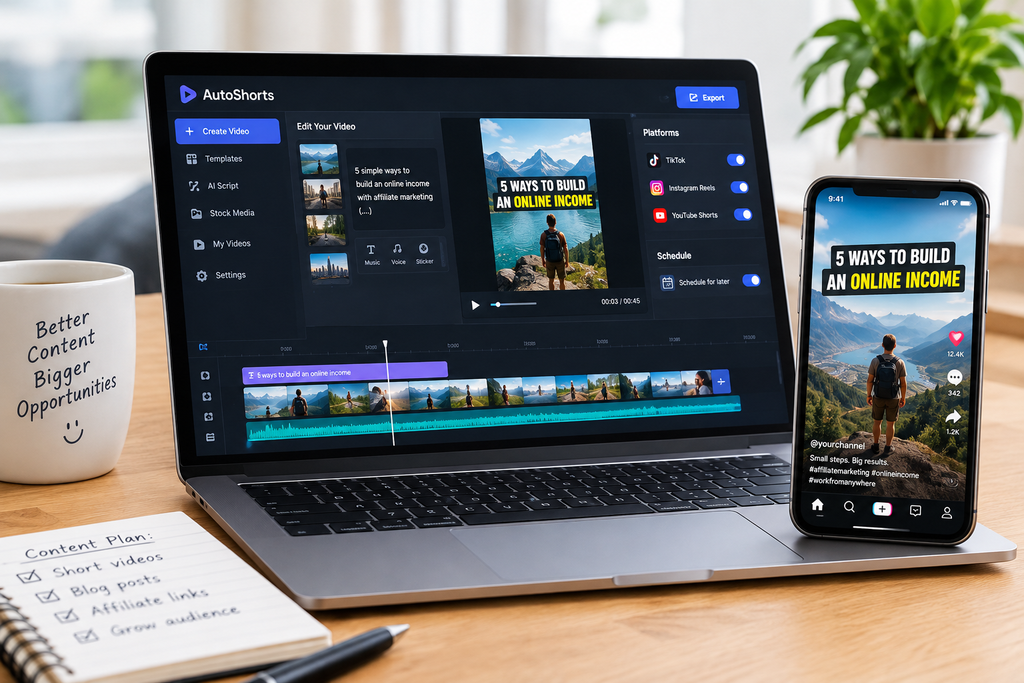
In this article, we will look at how AutoShorts can help content creators produce short-form videos.
Additionally, we will examine how it fits into an online marketing strategy and what beginners should consider before using it.
What Is AutoShorts?
AutoShorts is an AI-powered video creation tool designed to help creators turn content into short videos for social media platforms.
Depending on the workflow you choose, AI video tools can help reduce the amount of manual work involved in creating content. AutoShorts is worth exploring if you want to produce videos for platforms such as TikTok, Instagram Reels, and YouTube Shorts.
For creators interested in faceless content, this type of tool can be particularly useful because it can reduce the need to appear on camera or handle every editing task yourself.
Short-form videos offer another way to introduce people to your content, website, or affiliate recommendations.
For example, if your website teaches beginners about affiliate marketing, you could create short videos covering topics such as:
Three common affiliate marketing mistakes.
Free tools that help beginners get started.
How affiliate links work.
Ways to research products before promoting them.
Simple strategies for creating useful online content.
Each video can focus on one specific problem and offer a practical solution.
You do not need to cover everything in a single video. In fact, focusing on one useful takeaway makes it easier for viewers to understand your message.
The goal is to attract the right audience by providing helpful information rather than simply asking people to buy something.
How AutoShorts Can Help You Create Content
One challenge with social media marketing is maintaining a consistent publishing schedule.
AutoShorts.ai offers a workflow for creating faceless videos, previewing and customizing the results, and scheduling content for connected channels.
Here are three ways this type of tool can fit into your content strategy.
1. Create Faceless Video Content
Not everyone feels comfortable recording themselves on camera.
Faceless videos provide an alternative. You can create educational content, business tips, motivational videos, and other niche-specific material without making yourself the center of attention.
This can be helpful if you are building an online brand but prefer to keep your personal life private.
2. Spend Less Time on Repetitive Tasks
Producing every video from scratch involves several steps: brainstorming, writing, editing, adding music, and preparing the final version for publication.
An AI-assisted workflow can help automate parts of this process.
However, you should still review your videos before publishing. Check that the information is accurate, the script sounds natural, and the visuals match your message.
Automation should help you produce better content more efficiently, not replace quality control.
3. Build a Repeatable Publishing Routine
Instead of deciding what to post every day, plan several topics in advance.
For example, you could create a weekly content plan with three themes:
Monday: A practical online business tip.
Wednesday: A useful tool or resource.
Friday: An affiliate marketing lesson for beginners.
Use AutoShorts to help with your video workflow, then review the finished content and schedule it where appropriate.
A simple routine is often easier to maintain than trying to publish something new whenever you have a spare moment.
How to Use Short Videos to Support Affiliate Marketing
Creating videos is only one part of the process. You also need a strategy for connecting your content with your website and the products you recommend.
Here is a straightforward approach for beginners.
Step 1: Choose a specific audience.
Decide who you want to help. For example, you might focus on people who are learning affiliate marketing without a large budget.
Step 2: Identify useful topics.
Answer common questions your audience has. Tutorials, mistakes to avoid, and tool comparisons can all provide useful starting points.
Step 3: Create short, focused videos.
Use AutoShorts or another suitable video tool to help produce content. Make sure each video delivers a clear takeaway.
Pay attention to watch time, engagement, clicks, and which topics generate meaningful interest. Use that information to improve future content.
If you recommend products through affiliate links, disclose your affiliate relationship clearly and honestly.
Remember that views do not automatically translate into website traffic or sales. Results depend on your content, audience, offer, and overall marketing strategy.
Is AutoShorts Worth Trying for Beginners?
AutoShorts may be worth exploring if your main challenge is creating faceless videos consistently and reducing the time spent on repetitive production tasks.
Before paying for any tool, consider the following:
Ease of use: Can you create content without spending hours learning the software?
Video quality: Do the generated videos fit your niche and audience?
Customization: Can you correct scripts and adjust the results to suit your style?
Publishing options: Does the tool support the platforms you intend to use?
Cost: Does the price make sense for your current budget and publishing goals?
Start by testing the workflow and reviewing the results before committing to a paid plan. AI-generated content still requires your judgment, editing, and original ideas.
AutoShorts can be one part of a broader content creation system, but it is not the only thing you need to build an online presence.
Depending on your goals, you may also benefit from:
A website or blog to publish detailed guides and tutorials.
Keyword research tools to discover what your audience is searching for.
Analytics tools to understand how visitors interact with your content.
An email marketing service to communicate with people who choose to subscribe.
You do not need to purchase everything immediately. Begin with the essentials, learn how to use them effectively, and add tools when they solve a genuine problem.
Final Thoughts
Creating consistent content can be challenging when you are starting an online business, especially if you are managing every task yourself.
AI-powered video tools such as AutoShorts can help simplify parts of the process and make it easier to experiment with short-form content.
The key is to combine useful tools with a clear strategy. Focus on answering real questions, publishing helpful content, and learning from your results instead of chasing views alone.
Your next step: Choose one question your target audience asks frequently and turn the answer into a short video. Publish it, measure the response, and use what you learn to create your next piece of content.
Disclosure: This article may contain affiliate links. If you purchase through one of these links, we may earn a commission at no additional cost to you. Always evaluate a tool based on your own needs and budget.
Starting affiliate marketing doesn’t have to cost a fortune. With free affiliate marketing tools, you can begin without expensive software, a professional team, or dozens of subscriptions.
What you need is a simple way to research ideas, create useful content, share affiliate links, and attract visitors.
The good news? Several free affiliate marketing tools can help you do exactly that.
In this guide, you’ll discover seven free affiliate marketing tools for beginners starting out while keeping expenses low.
1. Google Trends — Discover What People Are Searching For
Before creating content, it helps to understand what people are interested in.
Google Trends lets you explore search interest for different topics over time. You can compare ideas and identify subjects that are gaining attention.
For example, if you’re considering promoting productivity software, you could compare searches related to time management apps, project management tools, and AI writing assistants.
Choosing the right topics can make content creation easier.
Google Keyword Planner helps you discover keyword ideas and explore estimated search volumes and advertising competition. Access and features may depend on your Google Ads account setup.
Use it to brainstorm phrases your potential audience might search for, such as “best budgeting apps for beginners” or “how to choose email marketing software.”
Remember that search volume alone doesn’t guarantee traffic. Focus on answering a specific question better than competing pages do.
How to use it:
Start with a topic related to your niche.
Collect relevant keyword ideas.
Prioritize questions you can answer thoroughly.
Create one useful article for each distinct topic.
Visuals can make your website articles and social media posts more appealing.
Canva provides design templates that beginners can use to create blog graphics, Pinterest pins, social media images, and YouTube thumbnails without advanced design skills.
You don’t need to spend hours learning complicated design software.
Start with a simple layout, readable text, and a consistent style that fits your website.
How to use it:
Create a featured image for each important article.
Design social media graphics to promote your content.
5. Google Search Console — Monitor Your Website’s SEO
Publishing an article is only the beginning. You also want to understand whether search engines are discovering your content.
Google Search Console helps website owners monitor their site’s presence in Google Search. It can show search queries, impressions, clicks, and indexing information.
This is particularly useful when you’re building a new affiliate website and want to understand how your articles are performing.
How to use it:
Add and verify your website.
Submit your XML sitemap.
Check whether important pages are indexed.
Monitor which search queries bring impressions and clicks.
Improve articles when the data suggests an opportunity.
Keep in mind that a page being indexed doesn’t guarantee that it will rank highly or receive visitors.
As your affiliate marketing activities grow, managing links across different platforms can become confusing.
Bitly offers link-shortening and link-management features. Depending on your plan, you may also have access to click analytics.
Short links can be convenient when sharing content on social media, although you should always check the rules of your affiliate program before modifying affiliate URLs.
How to use it:
Organize links you share across different channels.
Use tracking features where available.
Compare clicks across promotional campaigns.
Keep a record of which links point to which offers.
Important: Never replace an affiliate link with a shortened URL if your affiliate program prohibits it or if doing so interferes with its tracking.
Starting with too many tools can create unnecessary work. Instead, choose a small group that solves your immediate problems.
Here’s a simple starting setup:
Research: Google Trends
Content creation: ChatGPT
Website SEO: Google Search Console
Graphics: Canva
Add the other tools when you have a clear reason to use them.
The goal isn’t to collect software subscriptions. It’s to publish helpful content, reach the right audience, and recommend relevant products.
Can You Start Affiliate Marketing Without Paying for Tools?
Yes. You can begin with free tools and upgrade later if a paid feature solves a real problem.
You may eventually decide to invest in website hosting, a domain name, specialist SEO software, or email marketing services. However, buying multiple subscriptions before you’ve established a workable content routine can make the process unnecessarily expensive.
Start small, learn what works, and spend money only when you understand how a tool supports your strategy.
Also remember that affiliate marketing takes time and effort. Free tools can make the work easier, but they don’t guarantee traffic, commissions, or income.
Final Thoughts
You don’t need a huge budget to begin learning affiliate marketing.
With a few carefully chosen tools, you can research topics, create content, monitor search performance, and promote relevant products without paying for a long list of subscriptions.
Choose one topic, help people solve a real problem, and publish your first useful article. Then use the information available to improve your next one.
Want a simple starting point? Visit Income Start Guide to explore practical guidance for taking your first steps toward affiliate marketing.